

Image Details
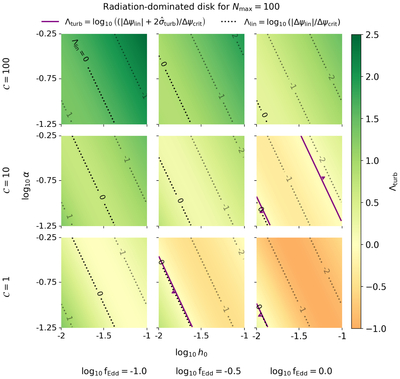
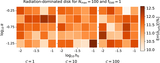
Caption: Figure 3.
For the radiation-dominated disk-embedded “golden” EMRI in Equation (14), we show (see Equation (17)) Λturb (=0; solid purple lines) as a function of ﹩\{{ \mathcal C },{{\rm{f}}}_{{\rm{Edd}}},\alpha ,{h}_{0}\}﹩ and overlay Λlin contour lines from Figure 2 (dotted black lines with Λlin = 0 shown prominently). Both Λturb and Λlin are defined relative to the minimum LISA-detectable dephasing Δψcrit ≡ 8/SNR = 0.16 rad, and signify whether the maximal turbulent dephasing ﹩| {\rm{\Delta }}{\psi }_{{\rm{lin}}}| +2{\hat{\sigma }}_{{\rm{turb}}}﹩ and the linear dephasing are LISA-observable, respectively. We use little arrows to point out the direction where Λturb > 0 due to the opposing behaviors of ﹩{\rm{\Delta }}{\psi }_{{\rm{lin}}}\propto {{\rm{f}}}_{{\rm{Edd}}}^{-1}{\alpha }^{-1}{h}_{0}^{-2}﹩ and ﹩{\hat{\sigma }}_{{\rm{turb}}}\propto {\alpha }^{1/2}{h}_{0}﹩ in different parameter regions. Each row is the same as Figure 2, and we vertically increase ﹩{ \mathcal C }﹩ from 1 to 100 row by row. The color bar is centered at 0 and ranges from −1 to 2.5. These results illustrate that for an extremely high-turbulence gas flow (﹩{ \mathcal C }\gtrsim 100﹩; top row), LISA EMRIs could have detectable gas-induced dephasing across our parameter spaces. Otherwise, either for ﹩{ \mathcal C }=10﹩ and fEdd ≳ 0.03, regions of parameter space emerge for h0 ≳ 0.03 and α ≳ 0.1, where the maximal turbulent dephasing is observable, while the Δψlin is not.
Other Images in This Article
Copyright and Terms & Conditions
© 2026. The Author(s). Published by the American Astronomical Society.

