

Image Details
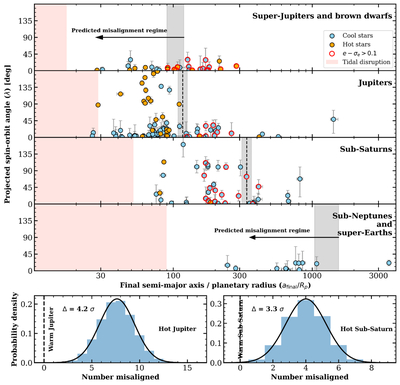
Caption: Figure 1.
The upper four panels show the projected spin–orbit angle ∣λ∣ as a function of orbital separation scaled by the planetary radius (afinal/Rp). The sample is divided into four mass-ratio regimes from top to bottom: super-Jupiters and brown dwarfs (q > 0.002), Jupiters (0.0003 < q ≤ 0.002), sub-Saturns (0.00005 < q ≤ 0.0003), and sub-Neptunes and super-Earths (q ≤ 0.00005). Blue and orange symbols denote systems with host-star effective temperatures below and above 6500 K (at 1σ), respectively. Red open circles indicate significantly eccentric orbits (e − σe > 0.1). The tidal disruption zone is computed from the median mass ratio of each panel, ﹩a/{R}_{p}\lt 2.7\,{({M}_{\star }/{M}_{p})}^{1/3}﹩ (J. Guillochon et al. 2011). Vertical dashed lines with shaded bands mark the afinal/Rp boundary that optimally separates the ∣λ∣ distributions of close-in and wide-orbit systems, determined via a bootstrap Kolmogorov–Smirnov test. In the first and fourth panels the gray bands are not measured but predicted from the Jupiter boundary via the tidal-circularization scaling (Qp = 5 × 10⁵ for super-Jupiters and brown dwarfs, 100 for rocky planets; see Section 4.2); misaligned orbits are expected interior to them. The bottom two panels show the expected number of misaligned systems obtained by randomly drawing samples without replacement from the close-in population, with each draw matched in size to the observed wide-orbit population. The black dashed line marks the observed number of misaligned wide-orbit systems. The complete machine-readable system table underlying this figure can be found here (github.com/wangxianyu7/Data_and_code/tree/main/WarmSubSaturnsTendToBeAligned).
(The data used to create this figure are available in the online article.)
(The data used to create this figure are available.)
Other Images in This Article
Copyright and Terms & Conditions
© 2026. The Author(s). Published by the American Astronomical Society.

