

Image Details
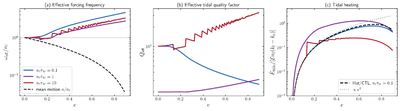
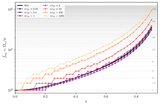
Caption: Figure 2.
Effective forcing frequency, tidal quality factor, and heating along constant angular momentum migration tracks. The calculation uses the full eccentric forcing spectrum for fixed values of nfτM. Panel (a) shows that the dissipation-weighted forcing frequency ωeff can differ substantially from both n and nf. Panel (b) shows the corresponding representative quality factor Qeff, which varies as the eccentric spectrum moves relative to the Maxwell peak. Panel (c) shows the dimensionless tidal heating rate. Heating peaks at intermediate eccentricity because the eccentric forcing weakens at low e, while the large semimajor axis along a constant angular momentum track suppresses the tidal amplitude as e → 1. The dashed curve shows the weak-friction Hut limit for nfτM = 0.1, and the dotted curve shows the leading e2 scaling.
Other Images in This Article
Copyright and Terms & Conditions
© 2026. The Author(s). Published by the American Astronomical Society.

