

Image Details
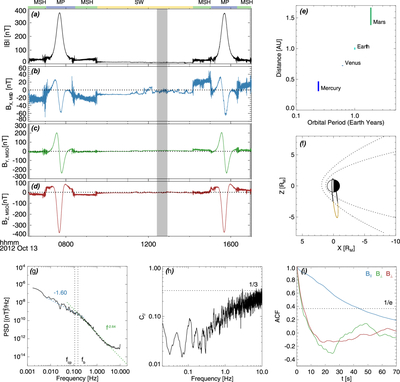
Caption: Figure 1.
Overview of a complete MESSENGER orbit around Mercury. Panels (a)–(d) show the magnetic field magnitude |B| and the three magnetic field components in the Mercury Solar Orbital (MSO) coordinate system on 2012 October 13. Colored bars at the top indicate different plasma regions, with green denoting the magnetosheath, blue the magnetosphere, and yellow the solar wind. Panel (e) shows the heliocentric distances and orbital periods of Mercury, Venus, Earth, and Mars. Panel (f) shows the trajectory of MESSENGER relative to Mercury for the interval in panels (a)–(d), with dashed curves marking the bow shock and the magnetopause. Panels (g)–(i) show the power spectral density (PSD), magnetic compressibility ﹩{C}_{\parallel }﹩, and the autocorrelation functions (ACFs) of magnetic field fluctuations calculated for 12:25:30–12:55:30 UT (highlighted by the gray shading). In panel (g), the PSD exhibits a spectral break and fitted slopes of −1.60 and −2.64 in the inertial and kinetic ranges. Vertical dashed lines indicate the average proton cyclotron frequency and the spectral break frequency. In panel (i), the blue curve denotes the parallel component, while the red and green curves denote the perpendicular components.
Other Images in This Article
Copyright and Terms & Conditions
© 2026. The Author(s). Published by the American Astronomical Society.

