

Image Details
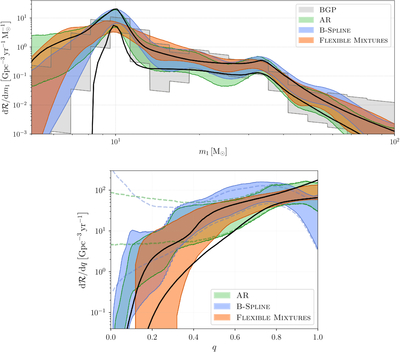
Caption: Figure 20.
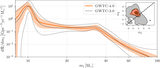
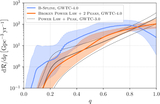
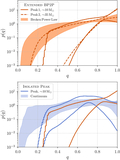
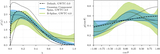
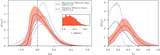
(Top) Primary mass distributions using the weakly modeled approaches outlined in Appendix C. The BROKEN POWER LAW + 2 PEAKS result is shown in black for comparison. All distributions show rates evaluated at z = 0.2, except for BGP, which shows the rate evaluated on the z = 0.1 − 0.25 bin. Note that Flexible Mixtures does not infer primary mass directly, but instead derives it from the chirp mass Gaussian mixture model and the mass ratio as a power-law distribution. The lack of substructure in the Flexible Mixtures mass distribution relative to the other models is likely due to model misspecification from assuming a power-law mass ratio model. (Bottom) Mass ratio distributions using the weakly modeled approaches outlined in Appendix C. The BROKEN POWER LAW + 2 PEAKS result is shown in black for comparison. Flexible Mixtures models the chirp mass as a Gaussian mixture model and the mass ratio as a power law. For the B-SPLINE and AR models, the separable distribution p(q) is shown by dashed lines and the conditional marginal distribution p(q∣m2 > 3M⊙) = ∫p(q)p(m1)Θ(m1q − 3)dm1 is shown by the shaded regions, highlighting that the low-mass ratio truncation seen in the strongly modeled approach is largely a prior effect.
Other Images in This Article
Show More
Copyright and Terms & Conditions
© 2026. The Author(s). Published by the American Astronomical Society.

