

Image Details
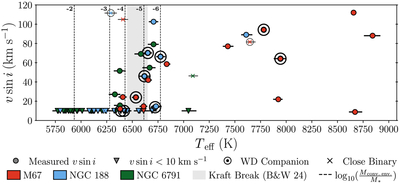
Caption: Figure 2.
The BSS ﹩v\sin i﹩ distribution by effective temperature, color coded by cluster (M67: red, NGC 188: blue, and NGC 6791: green). BSSs used in the analyses in this work with a measured ﹩v\sin i﹩ are marked by circles; those with a ﹩v\sin i﹩ below our floor of 10 km s−1 are marked with triangles at their upper limit. BSSs that have been discarded due to an orbital period less than 40 days are marked with an ×. BSSs without a ﹩v\sin i﹩ measurement are not plotted. Finally, BSSs with a known WD companion have a ring around their central point. Three distinct populations are apparent: cool stars that are all slowly rotating, hot stars that are primarily rapid rotators, and a population in between with a mixture of rotation rates. This final group are stars with thin convective envelopes that will spin-down, but slower than cooler stars with thick convective envelopes. For reference, we plot a dashed line at the maximum Teff at which the mass fraction of a convective envelope decreases by an order of magnitude among our Modules for Experiments in Stellar Astrophysics (MESA) models. The region of a mixture of BSS rotation rates and thin convective envelopes aligns well with the empirical Kraft break region of A. C. Beyer & R. J. White (2024, plotted as the gray-shaded area from 6450 to 6650 K), although is both cooler and hotter (roughly 6215–6750 K).
Other Images in This Article
Copyright and Terms & Conditions
© 2026. The Author(s). Published by the American Astronomical Society.

