

Image Details
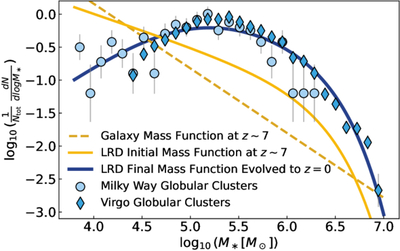
Caption: Figure 3.
The estimated evolution of the LRD mass function from z ∼ 7 (solid gold line) to z ∼ 0 (blue curve). We use the observed LRD UV luminosity function (V. Kokorev et al. 2024) and an extreme UV mass-to-light ratio that is consistent with a young globular cluster with an active supermassive star. We compare the predicted z ∼ 0 mass function to globular clusters in the Milky Way (light-blue circles; W. E. Harris 2010) and in Virgo (dark-blue diamonds; A. Jordán et al. 2009). The extrapolation of the z ∼ 7 galaxy stellar mass function (dashed gold line; R. Navarro-Carrera et al. 2024) to these M* has a distinct shape from the LRDs. All mass functions have been normalized by the total number to emphasize their shapes. LRDs can plausibly match the observed local globular cluster mass function using standard assumptions about their mass loss (see Section 3.1).
Other Images in This Article
Copyright and Terms & Conditions
© 2026. The Author(s). Published by the American Astronomical Society.

