

Image Details
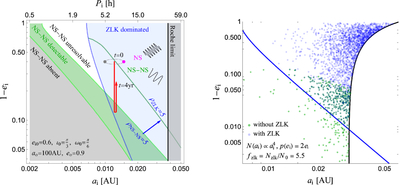
Caption: Figure 3.
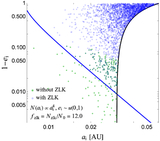
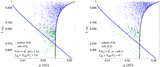
Dual-line gravitational radiation excitation through the ZLK effect for the Galactic Center NS–NS systems. Left panel: green contours show LISA-detectable systems without the ZLK effect, bounded by ρNS-NS = 5 (right) and ρNS-NS = 40 (left) in the ai–(1 − ei) parameter space. The light blue region indicates ZLK dominance, exemplified by a system with ei0 = 0.6 and Pi = 7 h. The magenta point represents a rapidly spinning NS component detectable by Cosmic Explorer (Figure 2). Without ZLK, this system has ρNS-NS = 0.16 (undetectable), but ZLK-driven eccentricity oscillations boost the SNR to 5.5 over 4 yr. The dark green contour shows the ZLK-modified SNR threshold ρZLK = 5, which extends into regions of larger orbital separation and lower eccentricity than the standard detection boundary. Right panel: Monte Carlo sampling of inner binary orbital elements, followed by ZLK-induced secular evolution calculations, indicates that this parameter-space expansion increases the number of detectable sources by ∼5-fold (or nearly an order of magnitude for the uniform eccentricity distribution; see Figure 4 in Appendix B). ZLK oscillations therefore promote wide binaries from unresolvable backgrounds into LISA’s detection window, substantially improving dual-line prospects and establishing the ZLK effect as a viable formation channel for Galactic Center dual-line systems.
Other Images in This Article
Copyright and Terms & Conditions
© 2026. The Author(s). Published by the American Astronomical Society.

