

Image Details
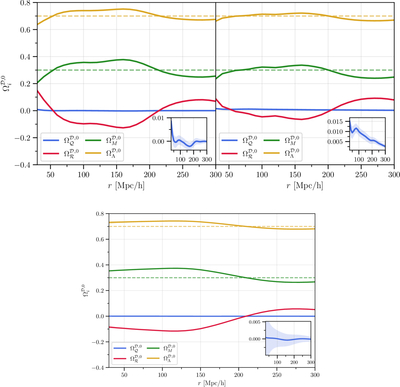
Caption: Figure 3.
The present-day averaged energy budget, as measured by the ﹩{{\rm{\Omega }}}_{i}^{{ \mathcal D },0}﹩ parameters, and computed within concentric spherical averaging domains ﹩{ \mathcal D }﹩ of varying comoving radius r, from r = 30 Mpc h−1 to r = 300 Mpc h−1, within various robustness tests. The green and yellow horizontal dashed lines in each panel represent the ΛCDM background values used in the reconstruction for ﹩{{\rm{\Omega }}}_{M}^{0}﹩ and ﹩{{\rm{\Omega }}}_{{\rm{\Lambda }}}^{0}﹩, respectively. The zoomed-in insets show ﹩{{\rm{\Omega }}}_{{ \mathcal Q }}^{{ \mathcal D },0}﹩, with the shaded areas denoting the 1σ statistical uncertainty bands. The top row shows the results obtained after applying to the CF4++ reconstruction either quenching corrections on the density contrast (left panel) or the cell-excision procedure (right panel). The cells containing nonlinear density contrasts—affected by these quenching or excision procedures—represent about 7% of the CF4++ within r = 300 Mpc h−1, and about 21% within r = 150 Mpc h−1. The bottom plot shows the results of employing the 16-cell sliding-window approach to the CF4++ results. See the main text of Appendix A for more details about these three test scenarios.
Other Images in This Article
Copyright and Terms & Conditions
© 2026. The Author(s). Published by the American Astronomical Society.

