

Image Details
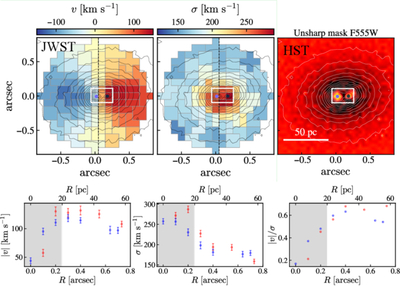
Caption: Figure 2.
First row, right panel: unsharp-masked WFPC2/F555W image of the double nucleus in NGC 4486B, showing two peaks separated by ∼12 pc. First row, left and middle panels: stellar kinematic maps of v and σ from JWST-NIRSpec IFU data, shown in Voronoi-binned cells. In all panels, surface brightness contours from the deconvolved WFPC2/F555W image are overplotted. The black dot marks the center of the faint peak (P2), which coincides with the σ peak from NIRSpec and is identified as the likely location of the SMBH. The purple dot indicates the center of the bright peak (P1), coinciding with the center of the IFU data cube. The vertical dashed line marks the kinematic center. Second row: 1D kinematic profiles of NGC 4486B derived from JWST-NIRSpec IFU data, showing the ∣v∣, σ, and ∣v∣/σ values along the major axis intersecting both nuclei. The red points represent the measurements and associated uncertainties from the right side of the kinematic maps, where σ peaks. The blue points correspond to the left side of the galaxy, mirrored about the rotation axis for direct comparison. The gray shaded region marks the approximate radial extent of the eccentric disk inferred from photometric and kinematic features (corresponding to the white rectangle above).
Other Images in This Article
Copyright and Terms & Conditions
© 2026. The Author(s). Published by the American Astronomical Society.

