

Image Details
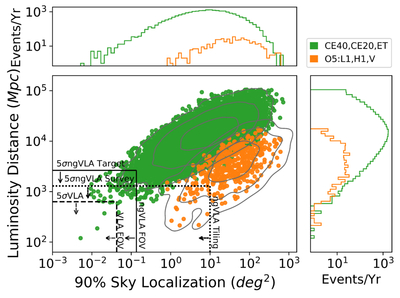
Caption: Figure 11.
Simulation results for a realistic population of BBHs as detected in 1 yr with a network of current-generation detectors of improved sensitivity (orange) and of next-generation detectors (green). Contours indicate equal-density regions from a Gaussian kernel density estimate, enclosing 50%, 90%, and 99% of the estimated probability distribution. We mark the areas that are accessible for radio follow-up with current-generation radio arrays such as the VLA (dashed lines), and next-generation interferometers such as the next-generation VLA (ngVLA; dotted and solid lines). We assume a radio luminosity of 1028 erg s−1 Hz−1 to evaluate the distance reach of the VLA and ngVLA for BBH radio afterglows in the minidisk scenario. See text for discussion.
Other Images in This Article
Copyright and Terms & Conditions
© 2026. The Author(s). Published by the American Astronomical Society.

