

Image Details
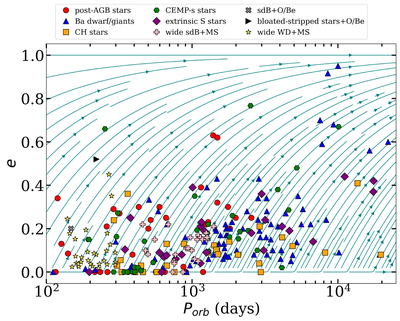
Caption: Figure 4.
Similar to Figure 3, but the data points now illustrate various wide postinteraction binaries. Red circles represent systems hosting post-AGB stars (G.-M. Oomen et al. 2018), blue triangles show barium dwarfs and giants (A. Jorissen et al. 2019; A. Escorza et al. 2019, 2020), orange squares show carbon-rich subgiants (A. Escorza et al. 2019, 2020), green pentagons illustrate carbon-enhanced metal-poor stars with s-process enhancement (T. T. Hansen et al. 2016; A. Jorissen et al. 2016; J. Sperauskas et al. 2016), purple diamonds show extrinsic S stars (F. C. Fekel et al. 2000; A. Jorissen et al. 2019; A. Escorza et al. 2020), pink pluses show sdB stars with main-sequence companions (B. N. Barlow et al. 2012; J. Deca et al. 2012; J. Vos et al. 2012, 2013, 2017, 2019; M. Dorsch et al. 2021; F. Molina et al. 2022), and bright yellow stars represent white dwarfs with main-sequence companions (N. Yamaguchi et al. 2024). The gray cross symbol corresponds to 60 Cyg (R. Klement et al. 2024), and the black triangle represents HIP 15429 (J. Müller-Horn et al. 2025).
Other Images in This Article
Copyright and Terms & Conditions
© 2026. The Author(s). Published by the American Astronomical Society.

