

Image Details
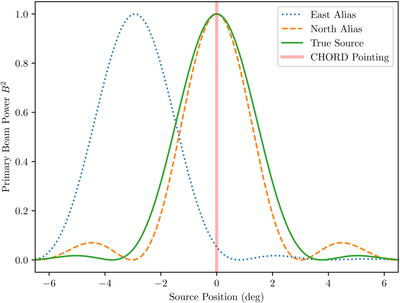
Caption: Figure 2.
Predicted primary-beam power for the true source location and closest alias locations as they move across the meridian. The north alias is about 1﹩\mathop{.}\limits^{{\unicode{x000b0}}}﹩4 away, and the east alias is about 1﹩\mathop{.}\limits^{{\unicode{x000b0}}}﹩9 away. Since the source is moving across the sky at a constant rate, the horizontal axis also corresponds to time. The source is located at the decl. CHORD is pointed to. The matched filter expects the signal to peak as the source transits the meridian, passing closest to the center of the primary beam, as shown in the “true source” curve. For an aliased position to the east (the blue dotted curve), the matched filter expects the signal to peak at the wrong time. For an aliased position to the north, the peak occurs at the correct time, but the detailed shape of the peak and its lobes do not match the data perfectly.
Other Images in This Article
Show More
Copyright and Terms & Conditions
© 2026. The Author(s). Published by the American Astronomical Society.

