

Image Details
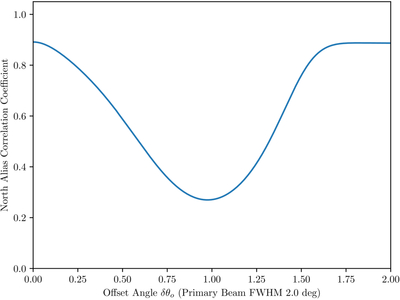
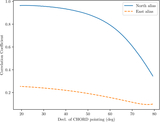
Caption: Figure 10.
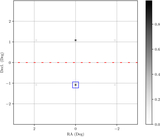
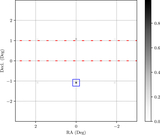
How the northern alias’s correlation coefficient changes depending on how much CHORD’s pointing is offset between strips (i.e., how far apart or separated the two dotted lines are in Figure 9). CHORD and the source are both located at Zenith. We are considering only one additional strip; a single small dither results in measuring nearly the same signal and provides almost no additional information. On the other hand, a very large offset means that both the true source position and the alias position are attenuated by the primary beam, so it is again impossible to distinguish between them. The minimum correlation coefficient occurs at an offset angle of δθo = 2°.
Other Images in This Article
Show More
Copyright and Terms & Conditions
© 2026. The Author(s). Published by the American Astronomical Society.

