

Image Details
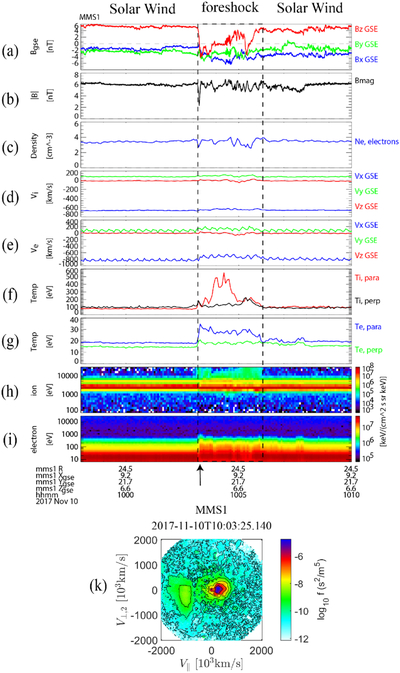
Caption: Figure 5.
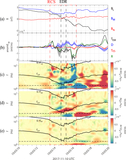
Event overview and ion velocity distribution function (VDF). (a) Magnetic field vector, (b) magnetic field magnitude, (c) electron number density, (d) three components of ion bulk flow, (e) three components of electron bulk flow, (f) ion parallel and perpendicular temperatures; (g) electron parallel and perpendicular temperatures, (h) ion and (i) electron omnidirectional differential energy fluxes, and (k) reduced two-dimensional (2D) ion VDF at ∼10:03:25 UT in the parallel–perpendicular velocity plane. The data are displayed in the Geocentric Solar Ecliptic (GSE) coordinate system. The 2D VDF reveals a population of reflected ions with velocities reaching ∼−1000 km s−1 in the antiparallel direction. Such super-Alfvénic reflected ions are a well-known signature of foreshock ion populations. Furthermore, as shown in Figure 5(h), we can see that reflected ions (>10 keV) appear during ∼10:03:15–10:06:00 UT. This indicates that MMS crossed the current sheet from the solar wind to the foreshock at 10:03:25 UT, and then it returned to the solar wind after 10:06:00 UT. The reconnecting current sheet is located at the boundary between the solar wind and the foreshock.
Other Images in This Article
Copyright and Terms & Conditions
© 2026. The Author(s). Published by the American Astronomical Society.

