

Image Details
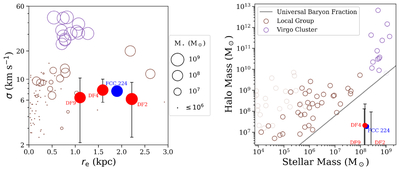
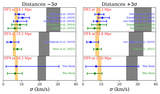
Caption: Figure 4.
A comparison between DF2, DF4, and DF9 (filled red circles) and a wider population of Local Group (open brown circles) and Virgo Cluster dwarf galaxies (open purple circles), both in terms of the measured velocity dispersion versus size (left, with the stellar mass indicated by the marker size in logscale) and the inferred halo mass versus stellar mass (right, with unreliable halo mass estimates given in light shading). FCC 224, a similar galaxy identified by M. L. Buzzo et al. (2025), is also shown (filled blue circle). Galaxies with similar velocity dispersions to DF2, DF4, and DF9 tend to have >100 times lower stellar masses and 2−6 times smaller radii, while galaxies with similar stellar masses tend to have >100 times more massive dark matter halos. Even at the upper bounds of their uncertainties, DF2, DF4, and DF9 fall below the universal baryon fraction (gray line); galaxies that formed within dark matter halos should not lie in this region, even if they convert all their baryons into stars.
Other Images in This Article
Copyright and Terms & Conditions
© 2026. The Author(s). Published by the American Astronomical Society.

