

Image Details
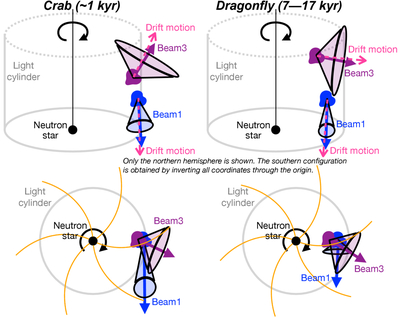
Caption: Figure 3.
Resolved four-beam templates for the very young Crab and adolescent Dragonfly pulsars. Schematic representation of the four-beam configuration for each pulsar, showing the locations of the lower-altitude and higher-altitude emission sites relative to the light cylinder. Only the northern hemisphere is shown, while the southern configuration is obtained by a point reflection through the origin, i.e., by flipping the signs of all coordinates. The inferred beam axes are interpreted as approximately tangential to the local magnetic-field-line directions at the fitted emission sites. In particular, the Beam 1 axis of the lower-altitude site lies close to the last closed field lines near the light-cylinder boundary and has only a small radial component in its inferred beam-axis direction. Instead, the Beam 3 axis of the higher-altitude site is expected to be shaped primarily by inertial sweepback (the toroidal, Parker-spiral-like magnetic field overlaid in each top view; E. N. Parker 1958; F. C. Michel 1973; S. V. Bogovalov 1999; J. G. Kirk et al. 2009) rather than uniquely tracing the dipole direction. For clarity, the opening angle of each cone is schematic and does not represent the fitted angular width or sharpness of that beam, which is energy dependent.
Other Images in This Article
Copyright and Terms & Conditions
© 2026. The Author(s). Published by the American Astronomical Society.

