

Image Details
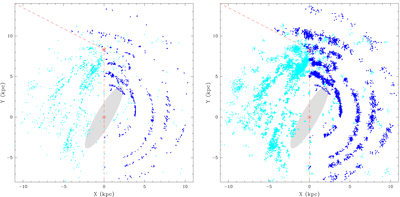
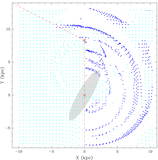
Caption: Figure 5.
Left panel: map of high-mass star-forming regions that trace spiral structure in the Milky Way viewed from the North Galactic Pole. Distances were determined with the Bayesian approach described in this paper, which combines spiral arm locations, association with giant molecular clouds that include sources with measured parallaxes, kinematic distance, and Galactic latitude information. Input catalogs included water and methanol masers, H II regions, and “red” MSX sources. Dark blue dots indicate sources associated with spiral arms, while the lighter cyan dots could not be confidently associated with any arm. The dashed red lines separate the regions of the Milky Way mapped with northern hemisphere telescopes (right side) from that yet to be mapped with southern hemisphere telescopes (left side). The shaded ellipse provides a schematic indication of the Galactic bar. Right panel: same as the left panel, except that each catalog source is represented by 5 “dots,” spread randomly about the estimated position using a Gaussian kernel with σ = 100 pc to better represent multiple sources of star formation in a giant molecular cloud. Spiral arms evident in the figures, starting from near the Galactic center and moving outward, are the Norma, Scutum, Sagittarius, Local, Perseus, and Outer arms.
Other Images in This Article

Show More
Copyright and Terms & Conditions
© 2016. The American Astronomical Society. All rights reserved.

