

Image Details
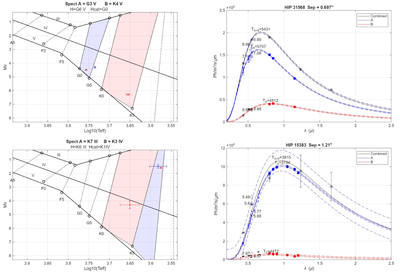
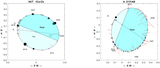
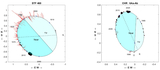
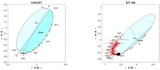
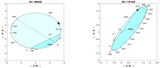
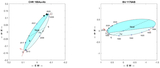
Caption: Figure 9.
HR diagrams for HIP 31568 (top left) and 15383 (bottom left). The filled blue square is the absolute magnitude using the Hipparcos Catalog V magnitude and distance modulus for the blended pair, and the temperature derived from our fit of the Hipparcos BVI and 2MASS JH magnitudes to a Planck function. The red filled circles are the magnitudes and temperatures of the components derived as discussed in the text and given in the tables. From top down, the three solid lines across the diagram mark luminosity classes III, IV, and V, while the vertical dotted lines specify spectral classes with data from M. Zombeck (2007). Shaded wedges are the areas over which bilinear fits are made and contain the spectral types and luminosity classes of the Hipparcos blended star and its two individual components. On the right are shown the corresponding Planck function photon fluxes (with dashed error ranges) from fits of catalog magnitudes to wavelengths for the blended pair (open circles with error bars), as well as the components (solid circles without error bars) that comprise it. Temperatures and V magnitudes are displayed next to the curves. At the top of the HR figures are the spectral types of the components from the fits, and the (combined) spectral type from the Hipparcos Catalog. At the top of the Planck curves are the approximate separations.
Other Images in This Article
Copyright and Terms & Conditions
© 2026. The Author(s). Published by the American Astronomical Society.

