

Image Details
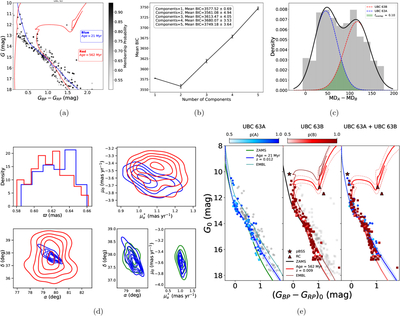
Caption: Figure 1.
(a) CMD of the 246 UBC 63 members with isochrones of 21 Myr (red) and 562 Myr (blue). (b) The BIC distribution for GMM models with 1–5 components obtained from 100 MC realizations. The mean BIC values along with their standard error for different number of components are also indicated. (c) Distribution of the difference in squared MD from the mean astrometric parameters of UBC 63A and UBC 63B, fitted with a two-component GMM. Blue and red curves denote UBC 63A and UBC 63B, respectively; the black curve shows the combined model, and the green shading indicates the overlap fraction. (d) Distributions of UBC 63A (blue) and UBC 63B (red) in parallax (upper left), proper motion (upper right), and α–δ space (lower left). The lower-right panel shows the spatial and kinematic distributions of UBC 63A (blue) and classical UBC 63 (green). (e) Isochrone fits to the CMDs of UBC 63A (left), UBC 63B (middle), and the combined population (right). Points are color coded by membership probability in UBC 63A (blues) and UBC 63B (reds); gray points represent the CMD points without reddening correction. The dashed curves represent the uncertainty bounds of the respective isochrone fits. The zero-age main sequence and the equal-mass binary locus are included in the left and middle panels, as indicated in the legend. The best-fit age and metallicity (z) are listed in the upper right and lower-left corners of the left and middle panels. The red star and triangle symbols in the middle and right panels mark a probable blue straggler star (pBSS) and two red-clump (RC) stars, respectively.
Other Images in This Article
Copyright and Terms & Conditions
© 2026. The Author(s). Published by the American Astronomical Society.

