

Image Details
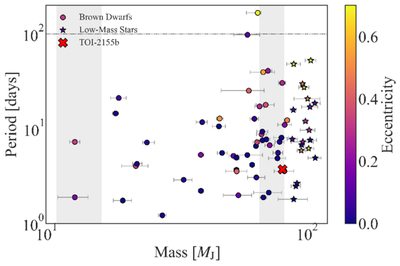
Caption: Figure 13.
Orbital period–mass diagram for transiting BDs (circles) and low-mass stars (star symbols), color-coded by orbital eccentricity. TOI-2155 b is highlighted with a red X. The shaded regions indicate the approximate transition regimes corresponding to the deuterium-burning limit (∼11–16.3 MJ) and the hydrogen-burning boundary (∼66–81.7 MJ), while the dotted horizontal line at 100 days illustrates the transition between short- and long-period systems. A trend emerges where longer-period objects tend to exhibit higher eccentricities, consistent with less efficient tidal circularization. In contrast, short-period BDs like TOI-2155 b typically occupy the low-eccentricity regime. High-mass BDs exhibit a broad range of eccentricities, underscoring the diversity of their dynamical histories and potential formation pathways.
Other Images in This Article
Show More
Copyright and Terms & Conditions
© 2026. The Author(s). Published by the American Astronomical Society.

