

Image Details
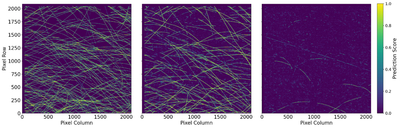
Caption: Figure 10.
Temporal maximum aggregated results for Sector 3, Camera 2, CCD 4. (Left) JPL tracks of known asteroids. (Middle) Our model prediction. (Right) The difference between the two (indicating tracks not present in the training data). The JPL Horizons track plots are binary (0 for no asteroid, 1 for asteroid), whereas our model outputs are in the range [0,1]. The longer tracks in the right panel are very clear detections over multiple data cubes, which are certainly real tracks. The short-length detections in the same panel are either (i) detections of asteroids not present in the training data, (ii) residuals between the detected tracks and the JPL Horizons tracks, or (iii) false positives. In follow-on processing, we do not consider a track to be valid unless it spans more than one data cube (i.e., > 64 pixels).
Other Images in This Article
Show More
Copyright and Terms & Conditions
© 2026. The Author(s). Published by the American Astronomical Society.

