

Image Details
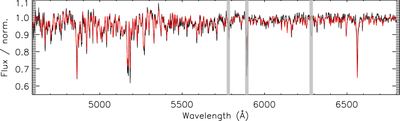
Caption: Figure 9.
The spectrum of KMT-2023-BLG-0164 with the best-matched template. The black line shows the observed spectrum of the target obtained with IMACS, while the red line represents one of the best-matched MILES template spectrum (HD186427; Teff = 5762 K, ﹩\mathrm{log}\,g=4.43﹩, and [Fe/H] = 0.07), convolved to a resolution of R = 1000. All spectra are continuum normalized. The three shaded regions indicate the masked wavelength ranges affected by interstellar absorption features, including the Na I D doublet and the DIBs at 5780 and 6283 Å.
Other Images in This Article
Show More
Copyright and Terms & Conditions
© 2026. The Author(s). Published by the American Astronomical Society.

Copyright ©
2026 Astronomy Image Explorer. All Rights Reserved.
