

Image Details
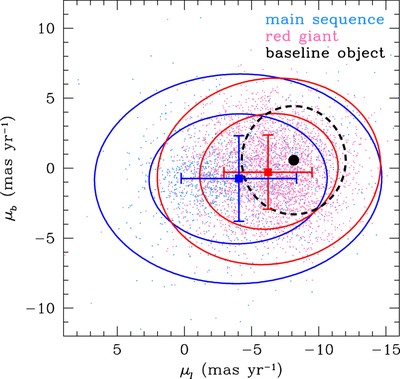
Caption: Figure 3.
Gaia proper motions of stars in the vicinity (within ﹩6^{\prime} ﹩) of KMT-2024-BLG-3237. The red dots are red-giant (bulge-population) stars, while the blue dots are main-sequence (disk-population) stars. In each population, the inner and outer contours envelope 68% and 95% of the stars, respectively. The red square corresponds to the mean proper motion of the bulge population, 〈μbulge 〉 (l, b) = (−6.22, −0.29) ± (3.28, 2.65) mas yr−1. The blue square is the mean proper motion of the disk population, 〈μdisk〉 (l, b) = (−4.06, −0.74) ± (4.29, 3.06) mas yr−1. The baseline object (source) is located at the black dot. The black circle represents the locus of the relative lens-source proper motions, μrel = 4.29 mas yr−1.
Other Images in This Article
Copyright and Terms & Conditions
© 2026. The Author(s). Published by the American Astronomical Society.

