

Image Details
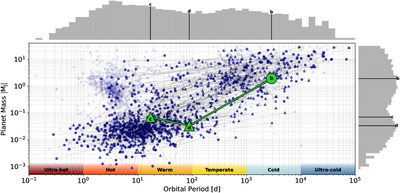
Caption: Figure 7.
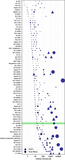
All exoplanets from the NASA Exoplanet Archive with known mass and orbital period. Triangle and circle point markers represent minimum and true masses, respectively. The larger green markers correspond to HD 190360’s three planets. All single-planet systems are made transparent, while all multiplanet systems are connected with a thin black line in order from shortest to longest period. Named period-bins are provided for reference according to rough temperature scales for planets orbiting main sequence FGK stars, and correspond to ﹩0\lt P\,\left[{\rm{d}}\right]\leqslant 1﹩ (ultrahot), ﹩1\lt P\,\left[{\rm{d}}\right]\leqslant 10﹩ (hot), ﹩10\lt P\,\left[{\rm{d}}\right]\leqslant 100﹩ (warm), ﹩100\lt P\,\left[{\rm{d}}\right]\leqslant 1000﹩ (temperate), ﹩1000\lt P\,\left[{\rm{d}}\right]\leqslant 1{0}^{4}﹩ (cold), and ﹩1{0}^{4}\lt P\,\left[{\rm{d}}\right]\leqslant 1{0}^{5}﹩ (ultracold). The gray histograms at the top and right correspond to the observed distributions of orbital periods and masses.
Other Images in This Article
Copyright and Terms & Conditions
© 2026. The Author(s). Published by the American Astronomical Society.

