

Image Details
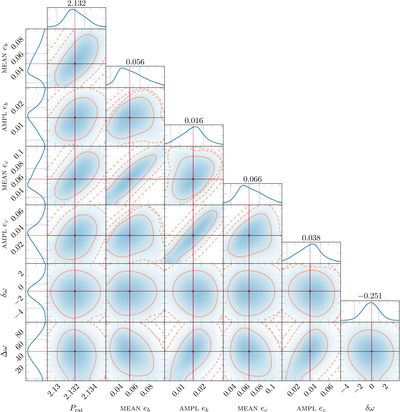
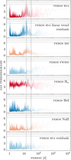
Caption: Figure 9.
Posterior distributions of the key dynamical parameters near the 2:1 MMR for the two-planet system, derived from a combined TTV + RV N-body model. A total of 10,000 samples were drawn from the posterior distribution and individually tested for long-term stability. The distributions reflect the system’s behavior in the vicinity of the 2:1 period ratio, highlighting the resonant and secular dynamics. We report the median values and peak-to-peak variations of the period ratio (﹩{\hat{P}}_{{\rm{rat.}}}﹩), eccentricities (﹩{\hat{e}}_{{\rm{b}}}﹩, ﹩{\hat{e}}_{{\rm{c}}}﹩), and apsidal angle difference (﹩\hat{{\rm{\Delta }}\omega }﹩), along with their dynamical amplitudes: Ampl. eb, Ampl. ec, and Ampl. Δω. Dynamically constrained planetary masses and semimajor axes are also shown. The resonant angles θ1 and θ2 are omitted as their evolution is dominated by circulation over the full 0°–360° range. Contours in the 2D distributions indicate the 1σ, 2σ, and 3σ confidence intervals of the stable posterior set.
Other Images in This Article
Show More
Copyright and Terms & Conditions
© 2026. The Author(s). Published by the American Astronomical Society.

