

Image Details
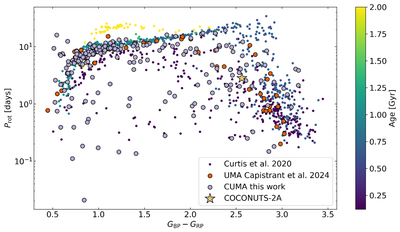
Caption: Figure 3.
Rotation period in days as a function of the Gaia (GBP − GRP) color for CUMA. The candidates and high-likelihood members are shown in light-purple points. We included the members of the UMA cluster from B. K. Capistrant et al. (2024) in orange. In addition we show extra known young clusters with measured rotation periods, color coded by age. We included the clusters compiled by J. L. Curtis et al. (2020): Pleiades (120 Myr; L. M. Rebull et al. 2016), Praesepe (670 Myr; S. T. Douglas et al. 2017, 2019), NGC 6811 (1 Gyr; J. L. Curtis et al. 2019), NGC 752 (1.4 Gyr; M. A. Agüeros et al. 2018), NGC 6819 (2.5 Gyr; S. Meibom et al. 2015), and Ruprecht 147 (2.7 Gyr; J. L. Curtis et al. 2020). We also included COCONUTS-2 A as a yellow five-point star, which has a measured rotation period. We found that the members of CUMA agree with the rotation period sequence of UMA, confirming that the two groups have the same age. We also found that the rotation period of COCONUTS-2 A agrees with the locus of the CUMA group, providing further support for its membership in the group.
Other Images in This Article
Copyright and Terms & Conditions
© 2026. The Author(s). Published by the American Astronomical Society.

