

Image Details

Caption: Figure 4.
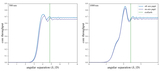
The relative complexity in real FLOPs among 2D Fourier-transform computations described in Table 2 is shown for varying the ratio of nonzero input samples N to output samples M (x-axis) with complexity on a log scale (y-axis). Panels left to right show increasing the overall size of N and M. For the (starshade → telescope) propagation ﹩N/M={N}_{s}/{N}_{P}^{\parallel }=20﹩, for the (telescope → focal plane) N/M = NP/Nf = 1. When a smaller number of output samples M < 50 is needed, the BDW and DFT method are optimal over the B-FFT. On the right, for larger input/output sizes N, M ≥ 200 as used in this work, the B-FFT is generally optimal.
Other Images in This Article



Show More
Copyright and Terms & Conditions
© 2025. The Author(s). Published by the American Astronomical Society.

