

Image Details

Caption: Figure 11.
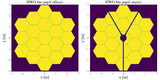
Core throughput within a photometric aperture of radius 0.7λ/D for wavelengths ranging from 500–1000 nm in steps of Δλ = 50 nm, shown in units of angular resolution (left panel) and milliarcseconds (right panel). These are shown overlaid for the off-axis aperture in blue and on-axis aperture in purple. Baseline HWO apertures are shown in Figure 8. Outside of the inner working angle, the core throughput is marginally lower for the on-axis aperture at 66% as compared to the off-axis aperture at 68%. Inside the IWA, both apertures have the same throughput. The starshade throughput is generally not highly dependent on wavelength; however, angular resolution worsens in the NIR. In the NIR, the starshade is able to image close-in planets at 2λ/D. We note the amplification of a source amplitude at the IWA, also seen in B. S. Gaudi et al. (2020), S. Shaklan et al. (2023), and C. Aime et al. (2024).
Other Images in This Article



Show More
Copyright and Terms & Conditions
© 2025. The Author(s). Published by the American Astronomical Society.

