

Image Details
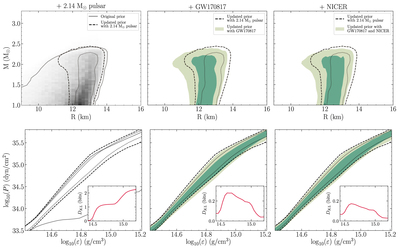
Caption: Figure 3.
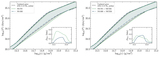
Posterior distributions conditional on the PP model and given: (i) the 2.14 M⊙ pulsar alone (left panels), (ii) inclusion of the GW170817 measurements (middle panels), and (iii) inclusion of the mass and radius of PSR J0030+0451 inferred by Riley et al. (2019a) given NICER data (right panels). In the top row we show how the posterior distributions update the prior distributions, by drawing a new central density given the inferred distribution on EOS parameters, ﹩p({\varepsilon }_{c}\,| \,\mathrm{EOS})﹩. This is then transformed to the space of masses and radii, with the contours indicating the 68% and 95% credible intervals. In the bottom row we show the marginal posterior distributions of the pressure P conditional on energy density ε, i.e., ﹩p(P\,| \,\varepsilon ,{\boldsymbol{d}},{ \mathcal M })﹩. The bands show the connected 68% and 95% credible intervals at each energy density ε. The gray lines in the left panels show the 95% credible interval of the full prior, while the black dotted and dashed lines in all panels show the 68% and 95% credible regions of the updated prior when including information from the 2.14 M⊙ pulsar. The green contours show the same credible regions, but for posterior distributions that are inferred from multiple measurements of NS observables. In the lower right inset panels we illustrate the evolution of the Kullback–Leibler divergence as a function of energy density. We conclude that most information is gained from including the 2.14 M⊙ pulsar. The binary merger GW170817 favors softer EOSs than the prior, but the measured radius from PSR J0030+0451 favors stiffer EOSs, resulting in a final posterior distribution very similar to the prior.
Other Images in This Article
Copyright and Terms & Conditions
© 2020. The American Astronomical Society. All rights reserved.

