

Image Details
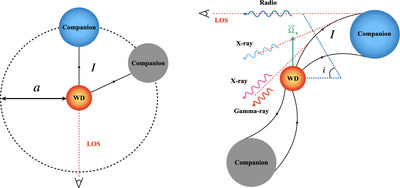
Caption: Figure 1.
The geometric sketch of the WD–MD unipolar induction magnetic interaction model. The left panel is the top view, and the right panel is the side view. The blue and black companions denote the configurations with and without observed radio emission, respectively. The radio emission (blue wiggler) is produced by relativistic particles in the magnetic loop connecting the two stars through relativistic ECME. High-energy emissions are predicted but are beamed in different directions, as marked as light blue wiggler (weak X-ray emission) via inverse Compton scattering, purple wiggler (strong X-ray emission) via relativistic boosting cyclotron radiation and red wiggler (γ-ray emission) via inverse Compton scattering off stellar light. The line of sight (LOS) is denoted as a red dashed line. The inclination angle i is defined as the angle between the LOS of radio emission and the orbital plane normal vector. The separation distance between the WD and companion star is a.
Other Images in This Article
Copyright and Terms & Conditions
© 2025. The Author(s). Published by the American Astronomical Society.

