

Image Details
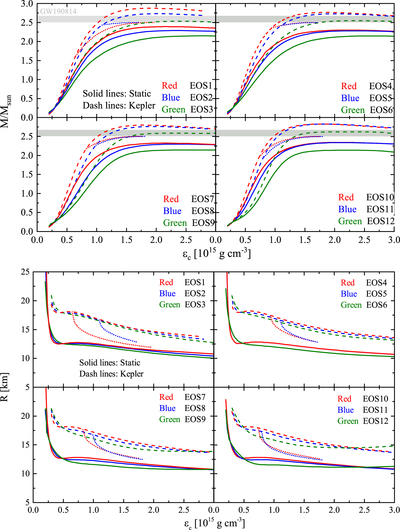
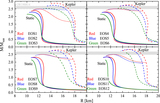
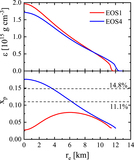
Caption: Figure 5.
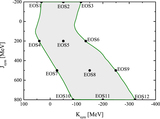
Mass (top) and equatorial radius (bottom) of static (solid lines) and rapidly rotating neutron stars as functions of their central energy density for the EOS parameter sets marked in Figure 3 and listed in Table 1. The neutron stars rotating at their respective Kepler frequencies and at the minimum frequency f2.5 that can rotationally support a neutron star with mass 2.50 M⊙ are shown as dashed lines and dotted lines, respectively. The reported mass 2.50–2.67 M⊙ of GW190814's secondary component is shown as a gray band.
Other Images in This Article
Copyright and Terms & Conditions
© 2020. The American Astronomical Society. All rights reserved.

Copyright ©
2026 Astronomy Image Explorer. All Rights Reserved.
