

Image Details
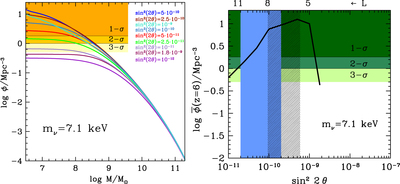
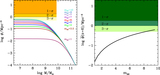
Caption: Figure 1.
Left panel: the cumulative mass functions computed at z = 6 for RP sterile neutrino models with ﹩{m}_{\nu }=7.1\,\mathrm{keV}﹩ for different values of the mixing angle θ shown by the labels on the right. The shaded areas correspond to the observed number density of galaxies with ﹩{M}_{\mathrm{UV}}\leqslant -12.5﹩ within within the 1-σ, 2-σ, and 3-σ confidence levels. Right panel: the maximum value ﹩\overline{\phi }﹩ (including theoretical uncertainties) of the predicted number density of DM halos at z = 6 for the case with ﹩{m}_{\nu }=7.1\,\mathrm{keV}﹩ as a function of the mixing angle θ. The upper shaded areas represent the observed number densities of galaxies with ﹩{M}_{\mathrm{UV}}\leqslant -12.5﹩ within the 1-σ, 2-σ, and 3-σ confidence levels. The vertical filled area corresponds to the range of values of ﹩{\sin }^{2}(2\theta )﹩, consistent with the tentative line signal 3.5 keV in X-ray spectra (Boyarsky et al. 2014; Bulbul et al. 2014), with the hatched vertical area corresponding to present upper limits on ﹩{\sin }^{2}(2\theta )﹩ from the absence of such a line in the spectra of the Milky Way, and of dwarf galaxies from several authors, as given in Riemer-Sorensen (2016) and references therein.
Other Images in This Article
Copyright and Terms & Conditions
© 2017. The American Astronomical Society. All rights reserved.

