

Image Details
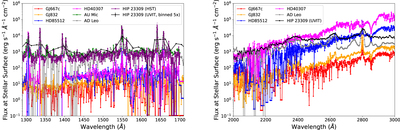
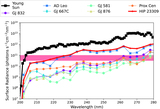
Caption: Figure 5.
Stellar flux of HIP 23309 at the stellar surface (﹩{F}_{\star }\times \tfrac{{d}_{\star }^{2}}{{r}_{\star }^{2}}﹩) in the FUV (left) and NUV (right), compared to other low-mass stars. Main-sequence comparison stars are ordered by T eff (Loyd et al. 2016). HIP 23309's stellar flux is much higher than mature stars of similar spectral type at short wavelengths due to enhanced activity because of its young age but converges with them at longer wavelengths where photospheric emission dominates. HIP 23309's flux in the FUV is similar to AU Mic’s, another extremely young M-dwarf of a similar spectral class. Overall, our spectra of HIP 23309 appear sensible in the context of other measured spectra of low-mass stars.
Other Images in This Article
Copyright and Terms & Conditions
© 2023. The Author(s). Published by the American Astronomical Society.

