

Image Details
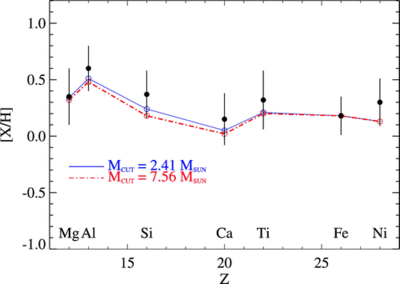
Caption: Fig. 13.
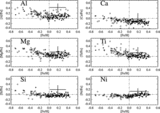
(a) Observed abundances (filled circles with error bars) compared with the expected abundances in the secondary star after having captured 5% of the matter ejected within the solid angle subtended by the secondary from a non–spherically symmetric supernova explosion of EK = 1052 ergs for two different mass cuts, Mcut = 2.41 M⊙ (solid line with open circles) and Mcut = 7.56 M⊙ (dash‐dotted line with open circles). This model corresponds to the matter ejected in the equatorial plane of the primary, where we assume that the secondary star is located (for more details, see González Hernández et al. 2005). (b) Same as (a), but in this model we have assumed complete lateral mixing, where all of the material within given velocity bins is completely mixed. Two simulations are shown for two different mass cuts, Mcut = 2.41 M⊙ (solid line with open circles) and Mcut = 7.56 M⊙ (dash‐dotted line with open circles).
Other Images in This Article
Show More
Copyright and Terms & Conditions
© 2008. The American Astronomical Society. All rights reserved. Printed in U.S.A.

