

Image Details
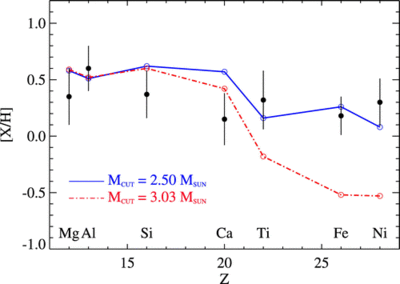
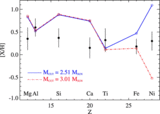
Caption: Fig. 10.
(a) Observed abundances (filled circles with error bars) compared with the expected abundances in the secondary star after having captured 15.5% of the matter ejected within the solid angle subtended by the secondary from a metal‐poor (Z = 0.004) 40 M⊙ spherically symmetric supernova explosion (MHe = 15.8 M⊙) with EK = 1051 ergs for two different mass cuts, Mcut = 2.50 M⊙ (solid line with open circles) and Mcut = 3.03 M⊙ (dash‐dotted line with open circles). The initial abundances of the secondary star were adopted for the average abundances of thick‐disk stars with [Fe/H] = −0.7 ± 0.2, and the initial orbital distance was ac,i ≈ 6 R⊙. (b) Same as (a), but for a spherically symmetric hypernova explosion (EK = 30 × 1051 ergs) for mass cuts of Mcut = 3.03 M⊙ (solid line with open circles) and Mcut = 4.02 M⊙ (dash‐dotted line with open circles).
Other Images in This Article
Show More
Copyright and Terms & Conditions
© 2008. The American Astronomical Society. All rights reserved. Printed in U.S.A.

