

Image Details
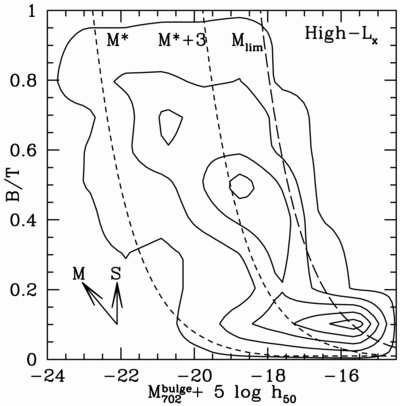
Caption: Fig. 9.
Top: The correlation between B/T and bulge luminosity is shown for galaxies in the high‐﹩L_{\mathrm{X}\,}﹩ clusters (left) and the low‐﹩L_{\mathrm{X}\,}﹩ clusters (right) after background subtraction. The sample is restricted to those galaxies in the local projected density range ﹩\Sigma _{\mathrm{local}\,}=50﹩–200 ﹩h^{2}_{50}﹩ Mpc﹩^{-2}﹩. The density of galaxies in this plane is represented as a contour plot; the contours are equally spaced in intervals of five galaxies per cell (starting with 1), where a cell is 1 mag and 0.1 in B/T. Galaxies with ﹩B/ T< 0.1﹩ are arbitrarily fixed at ﹩B/ T=0.1﹩ to be visible in these plots. The short‐dashed lines show the bulge luminosity of an M﹩^{*}﹩ galaxy and a galaxy 3 mag fainter, as a function of B/T, for reference. The long‐dashed line represents the luminosity limit of the sample. The arrows labeled "S" and "M" show the magnitude and direction a galaxy with ﹩B/ T=0.1﹩ would move if its disk faded by 1 mag (stripping: S) or its bulge brightened by 1 mag (merging: M). Bottom: Same as the top panel, but for the correlation between B/T and disk luminosity. Galaxies with ﹩B/ T> 0.9﹩ are arbitrarily fixed at ﹩B/ T=0.9﹩ to be visible in these plots.
Other Images in This Article
Show More
Copyright and Terms & Conditions
© 2002. The American Astronomical Society. All rights reserved. Printed in U.S.A.

