

Image Details
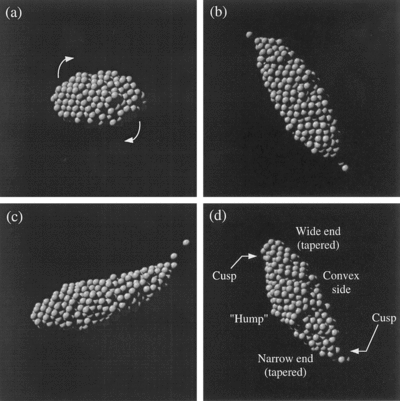
Caption: Fig. 4.
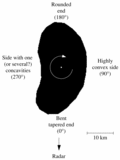
Four snapshots of the tidal breakup by Earth of a P = 6 hr prograde rotating rubble pile having q = 2.1 Earth radii, and ﹩v_{\infty }=8﹩ km s−1. (a) The asteroid before encounter. (b) The body shortly after perigee passage. (c) The later stages of tidal disruption as the body recedes from Earth. Particles shed near the tips do not return to the rubble pile. (d) The final shape of the object. Its spin (P = 5.03 hr) and elongation (about 2.9 times the mean diameter of the minor axes, or ﹩\epsilon _{\mathrm{rem}\,}\sim 0.65﹩) are virtually identical to those of Geographos (Fig. 1). Spiral distortion associated with tides produces a smooth convex surface along the long axis, cusps on either end, and a "humplike" mound of material on the opposing side.
Other Images in This Article
Copyright and Terms & Conditions
© 1999. The American Astronomical Society. All rights reserved. Printed in U.S.A.

