

Image Details
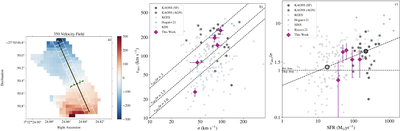
Caption: Figure 1.
(a) An example of a moment 0 map obtained from CASA, with trace apertures overlaid. (b) Maximum rotational velocity versus velocity dispersion for this work compared with disk-like DSFGs from the KAOSS sample (J. E. Birkin et al. 2024), typical star-forming galaxies from the KGES sample at z ∼ 1.50 (A. L. Tiley et al. 2021), ultraluminous infrared galaxies (ULIRGS) at z ∼ 2.5 from L. Hogan et al. (2021), and typical star-forming galaxies from the KDS sample at z ∼ 3 (O. J. Turner et al. 2017). The dashed lines indicate the various ﹩{v}_{\sin i}/{\sigma }_{0}﹩ that are commonly used: 1.0 for this work as determined by A. L. Tiley et al. (2021), J. P. Stott et al. (2016), 1.5 for J. E. Birkin et al. (2024) to account for additional turbulent motion, and 3.0, which is commonly used as a stricter criterion than the former. (c) ﹩{v}_{\sin i}/{\sigma }_{0}﹩ versus star formation rate for this sample compared with the KAOSS, KGES, and L. Hogan et al. (2021) samples, along with z ∼ 1.3–2.6 star-forming galaxies from SINS (N. M. Förster Schreiber et al. 2009) and z ∼ 4.5 DSFGs from F. Rizzo et al. (2021). The horizontal dashed line indicates the ﹩{v}_{\sin i}/{\sigma }_{0}=1.0﹩ criterion for rotationally versus dispersion dominated galaxies used in this work, and the horizonal line indicates the fit of the binned KAOSS and KGES median points.
Copyright and Terms & Conditions
© 2026. The Author(s). Published by the American Astronomical Society.

