

Image Details
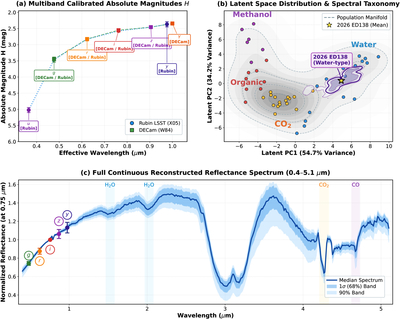
Caption: Figure 1.
End-to-end photometric calibration, latent taxonomic classification, and continuous optical-to-NIR reflectance spectrum reconstruction for dwarf planet candidate 2026 ED138. (a): Orbit-calibrated absolute magnitudes H across 0.35–1.05 μm, corrected for heliocentric/geocentric distance moduli and linear solar phase angle effects (β ≈ 0.107 mag deg−1). (b): Projection onto the two-dimensional latent principal component space (PC1 versus PC2) derived from the empirical prior manifold (Gray, background contours) of mid-sized TNOs surfaces. Markers locate the Training data with spectral classes: Methanol (purple), Organics (red), CO2 (orange), and Water-type (blue). The yellow star and dashed/solid purple contours mark the posterior mean and 1σ/2σ credible boundaries of 2026 ED138. (c): Reconstructed continuous reflectance spectrum spanning 0.4–5.1 μm, normalized at 0.75 μm. The solid dark-blue curve represents the median reconstructed profile, while dark and light blue shaded envelopes denote 1σ (68%) and 90% credible intervals, respectively. Colored circles with error bars show the observed grizy photometry used to infer the reflectance spectrum. Shaded vertical columns indicate the expected wavelengths of diagnostic absorption features for reference; they do not represent detected features.
(The data used to create this figure are available in the online article.)
(The data used to create this figure are available.)
Copyright and Terms & Conditions
© 2026. The Author(s). Published by the American Astronomical Society.

