

Image Details
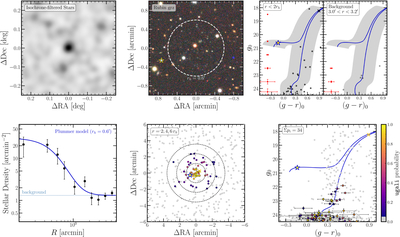
Caption: Figure 1.
(Top Left) Smoothed spatial distribution of isochrone-filtered stars in a small region surrounding Aquarius IV. (Top Center) EDP2 color coadd image of a much smaller region centered on Aquarius IV. (Top Right) CMD of stars located within ﹩2{r}_{h}\approx 1\mathop{.}\limits{^{\prime} }2﹩ of Aquarius IV (left) and in an equal-area background annulus (right). We highlight the candidate BHB star with a ⋆ due to its importance for our distance estimate. (Bottom Left) Radial density profile of isochrone-filtered stars. The best-fit Plummer model is shown in blue. (Bottom Center) Spatial distribution of stars in a ﹩12^{\prime} \times 12^{\prime} ﹩ region centered on Aquarius IV, colored by ugali membership probability; stars with probabilities pi < 0.05 are shown in gray. (Bottom Right) CMD of the same stars shown in the bottom-center panel. The brightest red giant branch star candidate (g0 ≈ 18; × symbol) is ruled out as a member due to its large Gaia DR3 proper motion.
Copyright and Terms & Conditions
© 2026. The Author(s). Published by the American Astronomical Society.

