

Image Details
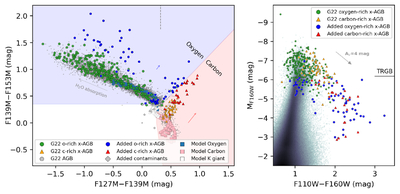
Caption: Figure 1.
Left: A color–color diagram showing our new and old (G22) chemically classified x-AGB candidates along with our chemical classification criteria (shaded regions) including our oxygen-rich (blue), carbon-rich (red), and contaminant regions (white). Atmospheric models for carbon-rich and oxygen-rich AGB stars are shown with pink and blue squares, respectively (B. Aringer et al. 2009, 2016). The vertical dashed line represents the separation between M-type sources with and without evidence of water absorption. Arrows show the direction and magnitude of circumstellar extinction for C- and M-type stars (see text). The full M31 AGB sample is shown with small gray circles. Right: A wide-band color–magnitude diagram showing the classified subsets with the same color scheme as the left panel. The tip of the red giant branch (TRGB) is also shown with a solid black line (F160M = 19.28 mag; M. L. Boyer et al. 2019). A Milky Way-like extinction vector with an AV = 6 mag is included to indicate the general direction of increased dust content (K. D. Gordon et al. 2023).
Copyright and Terms & Conditions
© 2026. The Author(s). Published by the American Astronomical Society.

