

Image Details
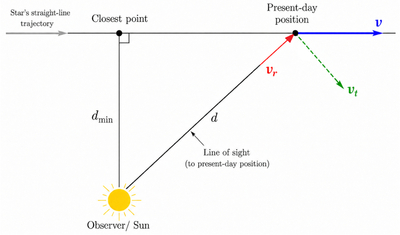
Caption: Figure 1.
Schematic illustration of the geometry of secular acceleration. The star moves with constant velocity v along a straight trajectory relative to the observer. At the present-day position, the line-of-sight distance is d, and the velocity decomposes into radial and tangential components, vr and ﹩{v}_{{\rm{\tan }}}﹩. The point of closest approach lies at the perpendicular distance ﹩{d}_{{\rm{\min }}}﹩ from the observer. Although v is constant, the projection onto the instantaneous line of sight changes with time, producing a secular drift of the measured radial velocity.
Copyright and Terms & Conditions
© 2026. The Author(s). Published by the American Astronomical Society.

Copyright ©
2026 Astronomy Image Explorer. All Rights Reserved.
