

Image Details
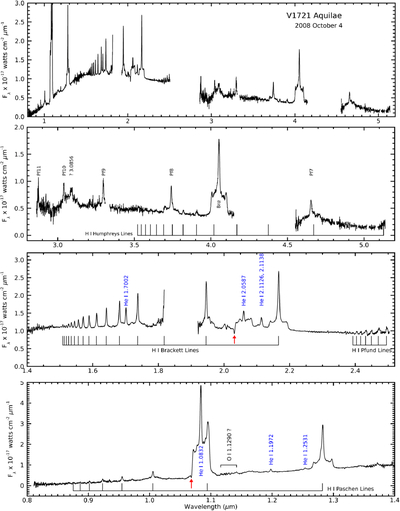
Caption: Figure 1.
Infrared spectrum of the nova V1721 Aquilae from 12 days after discovery. The top panel shows the entire spectrum and highlights the steep decline to the blue caused by the very high Galactic reddening. The numerous H I lines from the various series are generally identified with tick marks although, in the second panel down the Pfund series members and Brα are labeled directly in order to avoid confusion with the Humphreys series. He I lines, present in the lower two panels, are labeled in blue. Identification of the broad, low-contrast emission feature in the bottom panel with O I 1.1290 μm is based upon detection of its companion feature 0.8446 μm in the early spectra of L. A. Helton et al. (2008) and R. Hounsell et al. (2011). The unidentified feature in the second panel down is labeled with our best determined laboratory wavelength. The red arrows in the bottom two panels mark the only P-Cygni absorptions that we detected. They are on the broad components of He I 1.0832 and 2.0587 μm. Both of these helium lines have metastable lower levels that are significantly populated, resulting in sufficient optical depth to produce absorption features. None of the other lines in our spectral range, either broad or narrow, do so. The small, double-peaked feature at 2.0 μm is telluric in origin.
(The data used to create this figure are available in the online article.)
(The data used to create this figure are available.)
Copyright and Terms & Conditions
© 2026. The Author(s). Published by the American Astronomical Society.

