

Image Details
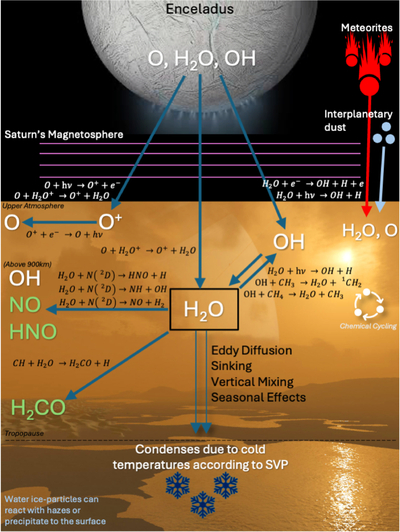
Caption: Figure 1.
Schematic showing the potential pathways of H2O and its transport through Titan’s atmosphere until condensation near the tropopause. Not all reactions have been included; for example, reactions related to hydronium (protonated water), and some ion and neutral production and loss pathways are not included. The purpose of the schematic is to give a general overview of the main chemical interactions related to H2O and oxygen species. O, OH, and H2O are injected into Titan’s atmosphere via Enceledan plumes, meteorites, and/or interplanetary dust. These molecules go through dissociation, charge exchange, and electron impacts in Saturn’s magnetosphere. In Titan’s upper atmosphere, OH combines with methane and its derivatives to form H2O, which can either go on to form other oxygen-bearing molecules like HNO or destroyed into OH again. There is a cyclic process between OH and H2O. If not destroyed, water subsides through the atmosphere until condensation or potential interactions with hazes. The chemistry shown in the diagram is based on V. Vuitton et al. (2019) and C. A. Nixon (2024). Molecules in green denote that they are predicted by photochemical models but have not yet been detected.
Other Images in This Article
Show More
Copyright and Terms & Conditions
© 2026. The Author(s). Published by the American Astronomical Society.

