

Image Details
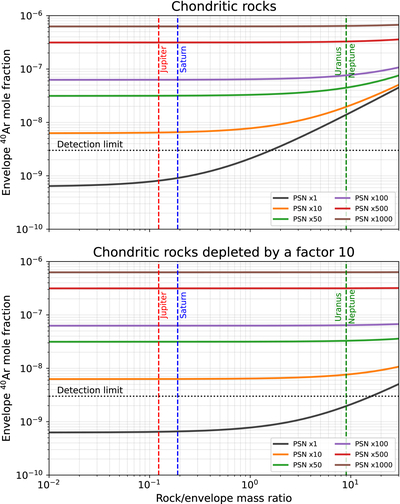
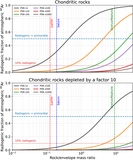
Caption: Figure 4.
Envelope 40Ar mole fraction as a function of the rock-to-envelope mass ratio for a giant planet under different assumptions regarding the primordial 40Ar enrichment inherited from the PSN. The upper panel assumes a chondritic potassium abundance in the rocky component, whereas the lower panel assumes a potassium abundance depleted by a factor of 10. Colors indicate primordial 40Ar enrichments of 1, 10, 50, 100, 500, and 1000 times the adopted protosolar value. The increasing contribution of radiogenic 40Ar produced by 40K decay causes the curves to rise with increasing rock-to-envelope mass ratio, with this effect being substantially reduced in the potassium-depleted case. Vertical dashed lines mark the present-day heavy-element-to-envelope mass ratios inferred for Jupiter, Saturn, Uranus, and Neptune, here interpreted as rock-to-envelope mass ratios under the end-member assumption that the entire heavy-element inventory is contained in rocky material. The horizontal dotted line indicates the nominal detection limit for in situ measurements.
Other Images in This Article
Copyright and Terms & Conditions
© 2026. The Author(s). Published by the American Astronomical Society.

