

Image Details
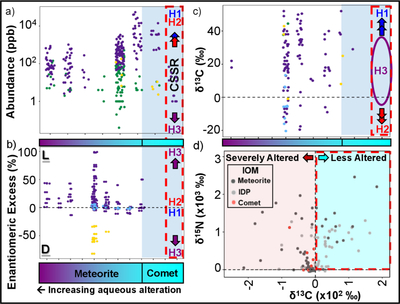
Caption: Figure 4.
A compilation of organic data (amino acids (purple), N-heterocycles (green), sugars/sugar acids (yellow), and hydroxy acids (blue)) from meteorites, comets, and interplanetary dust particles (IDPs) that would be used to help evaluate the origin of biologically relevant organic molecules (hypotheses 1, 2, or 3 (i.e., H1, H2, H3)) on comet 67P. The arrows point in the direction the organics in question would plot if H1–H3 were true. From right to left, data are plotted from less altered materials (e.g., IDPs) to more altered meteorites (up to CI1). (a) Abundance of organic compounds plotted on log scale. Amino acids are generally much more abundant than N-heterocycles and sugars. (b) EE of amino acids (L-enriched) and sugar derivatives (D-enriched). (c) δ13C of organic compounds, predominately AAs. (d) δ15N vs. 13C of IOM, used to determine how relatively altered a particular sample is. Note that the samples collected from Stardust (labeled comet) plot with other severely altered materials. Data acquired from C. O. Alexander et al. (2007), B. T. De Gregorio et al. (2010, 2013), Y. Furukawa et al. (2019), D. Bockelée-Morvan et al. (2008), P. Rousselot et al. (2014), J. Manfroid et al. (2009), S. Wyckoff et al. (2000), Z. Martins et al. (2007), J. C. Aponte et al. (2020), H. Busemann et al. (2009), J. E. Elsila et al. (2012), C. Floss et al. (2006, 2014), K. D. McKeegan et al. (2006), G. Matrajt et al. (2008), A. S. Burton et al. (2013), G. Cooper & A. C. Rios (2016), J. R. Cronin & S. Pizzarello (1997), D. P. Glavin & J. P. Dworkin (2009), D. P. Glavin et al. (2006, 2008, 2010, 2012, 2021), S. Pizzarello & W. Holmes (2009), S. Pizzarello et al. (2003, 2006, 2008, 2010, 2012), O. Botta et al. (2002), K. E. Smith et al. (2014), and P. G. Stoks & A. W. Schwartz (1979).
Other Images in This Article

Show More
Copyright and Terms & Conditions
© 2026. The Author(s). Published by the American Astronomical Society.

