

Image Details
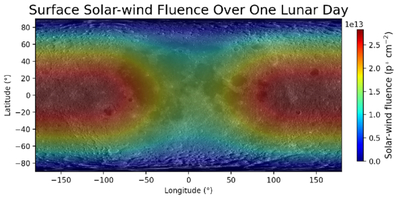
Caption: Figure 1.
Modeled solar-wind fluence at the surface over one lunar day as a function of latitude and longitude (D. M. Hurley & W. M. Farrell 2013; B. W. Denevi et al. 2023). The poles receive lower solar-wind fluences than the equator due to the higher SZA at high latitudes, which reduces direct access of particles to the surface. The nearside receives a lower solar-wind fluence than the farside due to the Moon’s tidally locked orbit, which results in the nearside spending most of the illuminated portion of a lunar day within Earth’s magnetotail.
Other Images in This Article
Show More
Copyright and Terms & Conditions
© 2026. The Author(s). Published by the American Astronomical Society.

Copyright ©
2026 Astronomy Image Explorer. All Rights Reserved.
