

Image Details
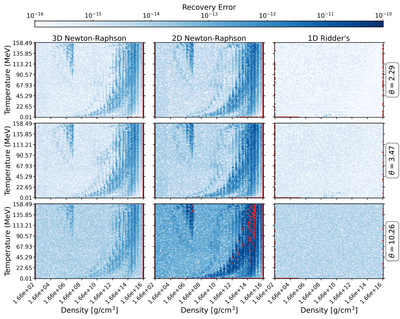
Caption: Figure 2.
Accuracy of con2prim in the (ρ, T) plane for different schemes for the DD2 EOS. The regions colored red are those where con2prim failed; i.e., con2prim did not converge or converged with a recovery error greater than 10−10. The regions colored blue are those where con2prim converged with an accuracy of at least 10−10, and the shade of blue represents the recovery error, with the darker shades representing higher recovery errors. The top panels show the results for different schemes for Case A: flat spacetime with velocity v = (0.9, 0, 0) and generalized Lorentz factor Θ ≃ 2.29. The middle panels show the results for Case B: CKS spacetime with v = (0.2, 0, 0) and Θ ≃ 3.47. The bottom panels show the results for Case C: CKS spacetime with v = (0.9, 0, 0) and Θ ≃ 10.26. We find that 3D Newton–Raphson and 2D Newton–Raphson show nonuniform convergence behavior, where the recovery error is higher (≲10−10) for densities ≳1014 g cm−3 and lower (≲10−12) elsewhere. On the other hand, the recovery error is uniformly low everywhere for the 1D Ridders’ method with values ≲10−15 at Θ = 2.29 and ≲10−13 at Θ = 10.26. Thus, the 1D Ridders’ method is more accurate, especially in high-density regions.
Other Images in This Article
Copyright and Terms & Conditions
© 2026. The Author(s). Published by the American Astronomical Society.

