

Image Details
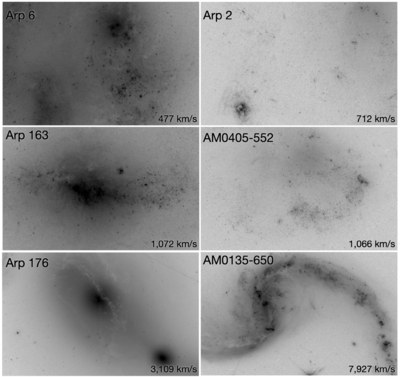
Caption: Figure 9.
Zoomed-in F606W images of galaxies from the atlas, showing the variety of morphologies and point-source populations at different distances (top left to bottom right), surface densities, and SFR intensities, all displayed with a common image scaling, as discussed in Section 2.1. (Top) The top row shows two examples of some of the closest, best-resolved, star-forming systems in the sample, but with very different surface densities and SFR intensities. Star formation produces the bright point sources seen in both systems, and drives some of the extended emission from ionized gas, like in the 30 Doradus-like H II region in Arp 2, which also hosts a likely nuclear cluster in the upper right. (Middle) Two star-forming systems at comparable distances, but further than those in the top row. The existence of brighter sources in Arp 163 (left) compared to AM0405-552 (right) suggests a higher SFR intensity, and/or younger ages, and a greater probability that the brightest sources are stellar clusters. (Bottom) Two more distant systems, beyond the limit where we expect to detect individual stars. The elliptical-dominated system (Arp 176) shows evidence for dense gas, traced by its dust lanes, but does not show a concentration of point sources that would indicate ongoing star formation. It does, however, show an extended distribution of point sources, which at this distance is most likely to be a population of globular clusters. The tidally disrupted spiral AM0135-650 (right) shows active star formation, which manifests as point sources along the arm, all of which are likely to be stellar clusters at this distance; we note that no such clusters are seen on the other arm (not shown, but see Figure B1). Images are oriented such that north is up. See Sections 2.4 and 3 for more guidance on interpreting these images.
Other Images in This Article
Show More
Copyright and Terms & Conditions
© 2026. The Author(s). Published by the American Astronomical Society.

